Growing winning dahlias for the love of the show
By Jean Sorensen
When Paul and Cheryl Howard step into their garden to care for their prize-worthy dahlia blooms, it is for the love of the show. There’s the excitement of competing with the best North American growers who can fill an exhibit area with a kaleidoscope of colorful blooms, seeing new varieties of dahlias introduced and grown, and the pride in seeing one’s entry land at the head table.
“You can walk into the Puget Sound Dahlia Association’s show and there are 3,500 blooms in the room,” Paul said. The show is billed as the largest in the U.S.
It only took a few wins at local shows early in their career and – as the saying goes – they were hooked.
It was the summer of 1998 when they planted the first tubers at the Richmond property, where Cheryl’s parents Dick and Norma Hengstler had three quarters of an acre lot and had lived there since 1958. Dick had passed away in 1998 but he had been a dedicated gardener who always planted blooms including dahlias. Norma was left to tend the garden, along with daughter and son-in-law, and she wanted to grow blooms that she could take to his grave site, tells Cheryl. Friend Frank Riley, a Fraser Valley and Vancouver Dahlia Society member with a flower allotment plot nearby gave the Howards 20 tubers.
The Howard family grew them again in 1999 and, modesty aside, – the dahlia blooms looked great! “We thought we should take them to the local garden club shows,” tells Paul. The couple selected blooms and took the cut dahlias to exhibit at both the Richmond and Burnaby Garden Club flower shows, where they had become members. Their dahlia exhibiting skills were rudimentary. As Paul recalls it amounted to mainly “putting them into a milk jug”. But, each time they returned home with winning ribbons. Those wins provided the impetus the couple needed in 2000 to take their blooms to another level.
That year the Howards entered their first Federation of Northwest Dahlia Growers sanctioned show through the Fraser Valley Dahlia Society, where they had become members since they lived in B.C.’s Fraser Valley region. They entered one of the most difficult classes – the triple – where growers exhibit three perfect blooms in one container.
They were elated when the triple won in its class but later in the show when Paul went back to admire the newly won ribbon, the table spot was bare. The entry was gone. “We thought someone had stolen it,” he said, but some quick queries found it had been lifted – but by the show judges to the head table. Pinned to the Glenplace (a miniature deep purple pompom) entry by the Howards was another ribbon – Best in Show.
In 2001, the Howards did their first U.S. major event participating in the Snohomish Country Dahlia Society show. They were novices but they came away with a ribbon as their triple took Best in Show. “Getting that first triple in that show was unbelievable,” Paul remembers. There have been other wins that the Howards savor such as winning at a national show, but that win at the Snohomish County will always be a stand-out. (See a list of some favorite wins at end of story).
Since then, the Howards have continued on a winning streak. They have lost count of the ribbons they have brought back to their Surrey, B.C. home just outside Vancouver. But, they have honed a system of growing and showing that have made them a competitor to watch at shows. “In our biggest year, we had 74 on the head table (at various shows),” he said. From 2000 to 2024, they had 600 entries land at the head table. “For best in shows, we have had 15 singles and triples – 20-15,” he said.
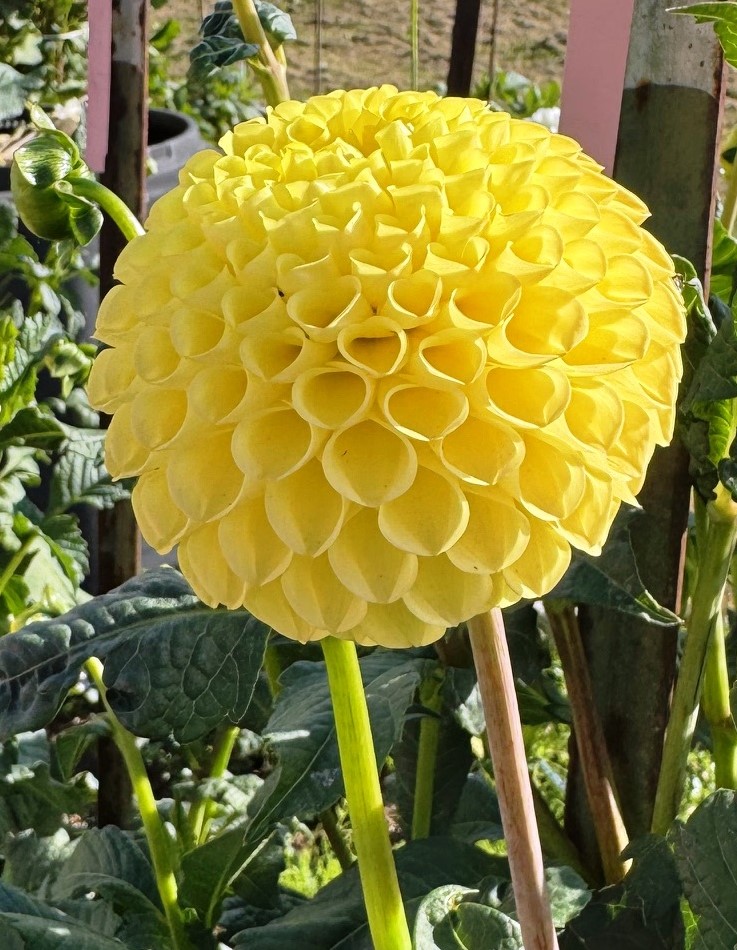
Some of the dahlias that the Howards found work best in exhibits include Kenora Challenger, Pam Howden, SB’s Star and Kenora Jubilee.
The Lady has the “Eye”
It’s a joint effort for Cheryl and Paul Howard when it comes to the long and precise process of getting the prize-worthy dahlias to a show tables. But, there are some aspects of the team work where one takes the lead over the other.
“Cheryl is the one with the eye,” said Paul, although he has the judging credentials, his wife has the intuitive eye for knowing which dahlias are going to land the ribbons.
“It has always been that way,” Paul said. “There are times when I have said ‘no’ to a bloom and she has won with it at the head table. So I have learned my lesson and I don’t argue”.
Paul, who retired in 2024 from Crown Packaging in Richmond after 38 years, does most of the digging today as he is at home. Cheryl is finishing off a long career of waitressing at White Spot, a job she has held for 42 years but in 2026 she is looking to retire. Cheryl started at the chain’s Richmond White Spot after high school graduation and later moved to Langley’s 200th street location. She does much of the paperwork around the entries but in consultation with Paul.
After many years together, they have honed a smooth working relationship. “In November, 44 years ago we started dating,” recalls Paul. He was born in Barbados where the family resided during his early years, but after the death of his father, his mother married a Canadian and the family came to B.C. At age 13 he started school in Richmond, the neighboring suburb of Vancouver where Cheryl was born and raised. When Paul was 17 and Cheryl was 15 their high school paths crossed. Paul had been working as ice-patrol at the local skating rink and Cheryl came skating with cousins. Seven years after meeting one another they married in 1988.
“Her family was great – her mum and dad treated me like a son,” he said. So it was that kind of relationship that started the family growing dahlias together in Richmond.
The mentors who helped the Howards were Frank Riley and Walt Wynne. Riley provided the first dahlias for the Howards to grow on the Richmond three-quarters of an acre lot. Walt Wynne of the Whatcom County Dahlia Society was a giant in the industry known for growing large dahlias and a hybridizer. He became a font of growing information. “He helped me a lot,” said Paul, recalling the man who would plant up to 10,000 tubers each year. Sadly, Wynne perished along with his stock in a house fire in February 2013. The 2013 ADS Classification and Handbook of Dahlias listed 25 of Walt and wife Cory’s originations. But, despite the mentoring, show awards and the years of accumulated knowledge, Paul admits it is still Cheryl’s eye for excellence that takes them to the winner’s table. “Once she stops – I’m done,” he said.
Developing a winning system
Those first 20 tubers grew into 600 planted at the Hengstler Richmond site. It would be their proving out and learning site over the next 15 years. It was also a place where one found the couple and Norma during dahlia season. “She was quite involved with us,” tells Cheryl. “There would be the three of us, we were always out in the garden weeding, working in the garden and she was out there helping.” Age took its toll: Cheryl’s mother eventually developed Alzheimer’s disease and the Richmond property was sold. The Howards moved their growing site to their South Surrey.
“We are down to about 280 plants now,” said Paul, as they were able to find a close friend with a piece of land they could use. The Howards grow approximately 40-50 different varieties each year. “We try to grow 10 of everything,” he said, which helps when attempting to enter the difficult classes such as the triples. Some varieties though are grown as singles.
The Howards are always on the hunt for new varieties. Ferncliffe Gardens in Mission, B.C., was the place where the Howards first began looking for new and interesting dahlias to plant. “That was a really great place, and, it helped us to get some variety,” said Paul, who still admires the grower. But, the couple also found that the tuber sales hosted each spring by clubs such as the Vancouver Dahlia Society (VDS) and the Fraser Valley Dahlia Society (FVDS) were a bounty of old and new favorites that had been proven out by B.C. members. As the years progressed, they travelled across to the U.S. and became members of the Snohomish County Dahlia Society. “That’s our home club now,” Paul said.
But, going stateside also meant finding new varieties and finding new ways to source tubers from different countries. Today, in B.C., Paul and Cheryl are still on the hunt and have an eye on what is happening internationally. They are known for bringing to B.C. tubers of interesting varieties from Europe and Australia and growers abroad are just as keen to learn what North American growers have produced.
“Everyone is trying to get everyone else’s variety,” Paul said. Some of the debuted dahlias he has brought to Canada include Granite Queen Bee (an anemone) and Judith Taylor (fimbriated).
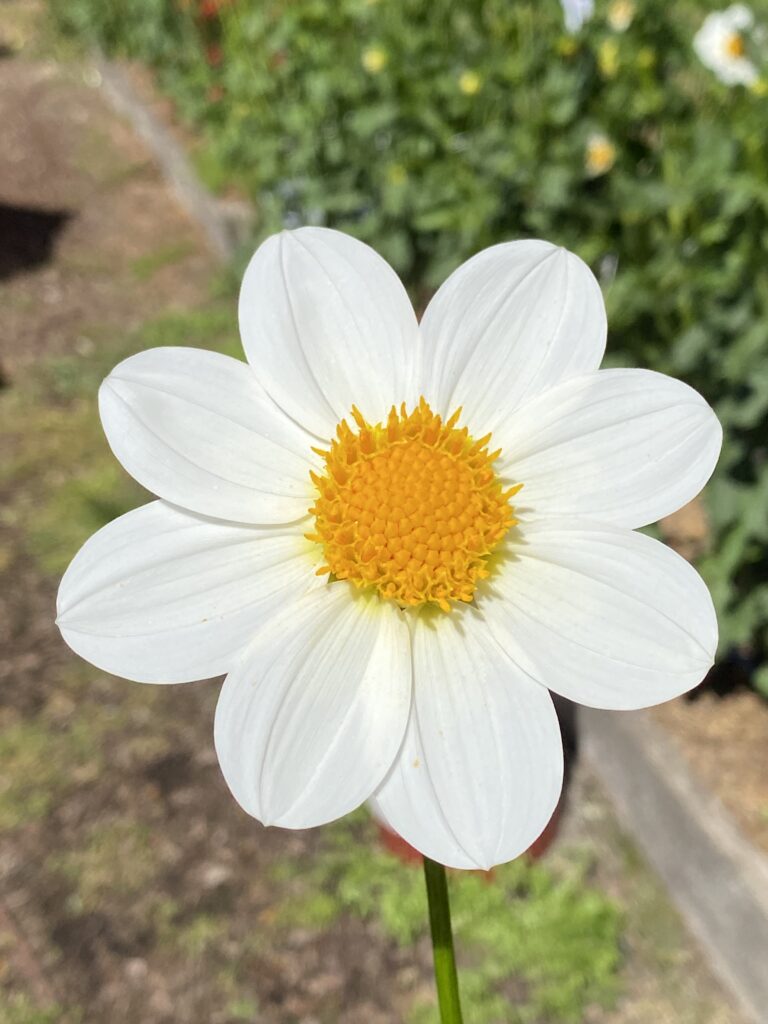
The Howards have hybridized dahlias, as well, but no longer since they do not have the space at their South Surrey location. Their original dahlias include: Lulu Island Mum (a white single), Lulu Island Dad (a yellow miniature ball), Lulu Island Art (a white medium sized formal decorative) and Lulu Island Jennifer (a dark red collarette), which the Howards have since lost.
The dirt around winning entries
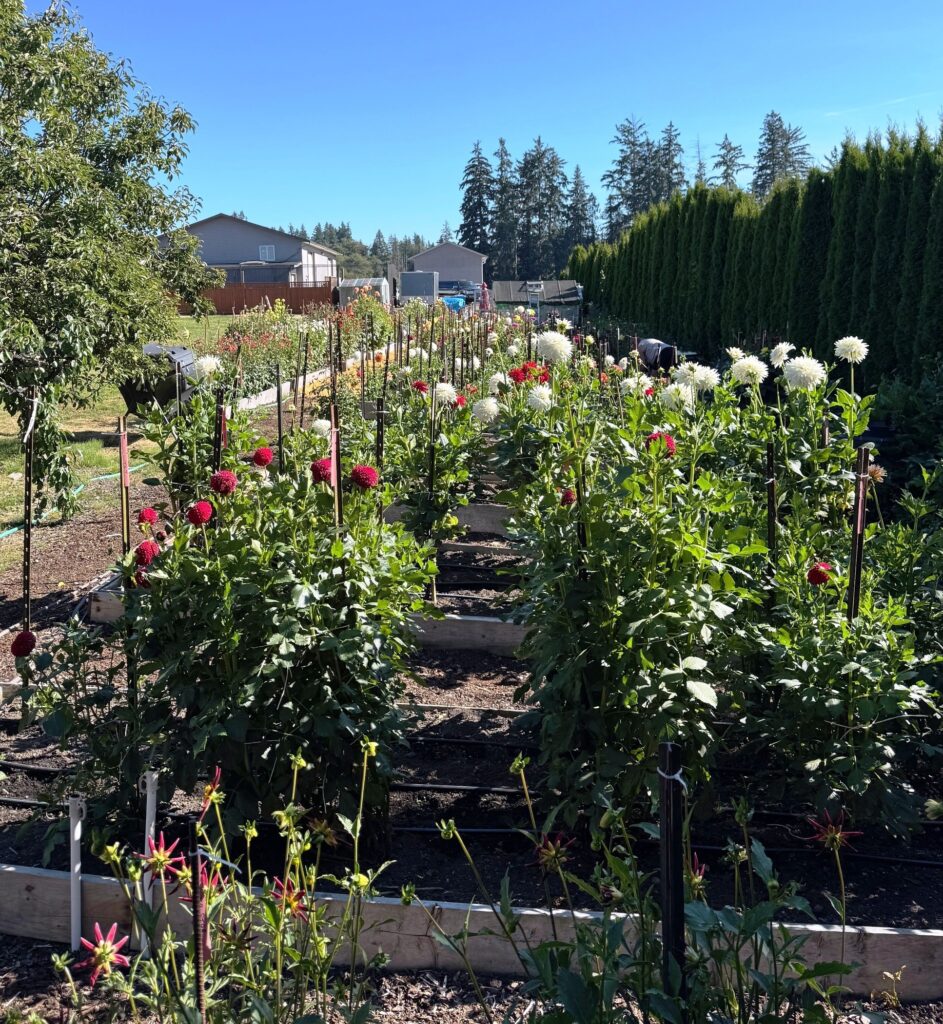
“We have 25 raised beds measuring four feet by 14 feet and there are 12 plants in each bed,” Paul estimates. The planting starts out with the shorter height varieties and then escalates to the taller dahlias as the planting progresses. The stepped height in the boxes allows for a clear view of blooms but also when harvesting the tubers, categorizing and storage becomes easier. “It’s a lot easier for the digging when you keep everything together,” said Paul.
The Howards plant each of their tubers horizontally and approximately three inches in the ground and uses metal stakes to support the dahlias during their growth. The rows are two feet apart in each box. The supporting stakes are left in the ground setting a marker for next year’s planting.
To gain the perfect blooms needed for exhibiting in multiple shows each year, the Howards turn to a high potency fertilizer such as Miracle-Gro’s 20-20-20, a water-soluble and balanced fertilizer but they will also occasionally combine it with a fish fertilizer. Plants that are producing show-worthy blooms need to be fed on a regular basis, Paul said, and he either sprays on the nutrients or water them in on a weekly basis. He’s not a proponent of slow release fertilizers – mainly because they continue to release nutrients when you want the tuber to stabilize and begin entering into dormancy.
His last feeding is in the first week of September. Should fertilizing continue, Paul has found, it results in tuber skins that become too thin and can affect how well the tubers store over winter. “The time release fertilizer will go on for too long,” Paul said. “If you rub your thumb on a potato the skin comes off – it is the same with the tuber,” he said.
After the last show and approximately 30-45 days before the tubers are to be dug, the Howards start cutting down the tops to encourage plants to set eyes.
Harvesting the tubers
The Howards cut their dahlias almost to the ground before digging to let the tubers set up eyes. “We dig and wash them,” he said, and the tubers are left to rest for a few days. “We use bread trays,” he said, those low-sided plastic crates that bread is delivered to stores in. The clumps are assigned a number designating the variety. Once the clumps have dried, the Howards cut for the eyes, and label the tubers with their catalogued number.
The Howards prefer a five-pronged pitch fork for digging the tuber clumps out of the ground, while a large knife is helpful for breaking down the clumps and the common Red&White (handled) garden shears are used for cutting.
“If there is a variety where I don’t see an eye, I will store as a clump,” Paul said, but only after he has used an adapted attachment on a drill that is able to spew out all the material captured between the tubers.
“Ninety-nine per cent of the time it is there it is going to rot,” he said if the material is not removed.
The Howards use their unheated garage, attached to their home, to store their tubers. “We put them in Rubbermaid clear plastic bins with the flat lids on top. The tubers are stored in Vermiculite and we don’t put the tops on until it gets cold,” Paul said. “We watch them and if we see condensation, then we take the lids off again.” The clear plastic also provides a view of what is going on with the tubers as storage progresses.
Pampering the show-bound dahlias
The Howards at one time attended eight shows annually but now are down to five on a regular basis. These include two sponsored by the Vancouver Dahlia Society in Vancouver and the Fraser Valley and three in the U.S. at Whatcom County, Puget Sound, and Snohomish.
With 10 plants of one variety, the Howards keep an eye on which dahlia are unfurling and heading toward the next competition. But, there are always the elements to deal with – such as sun that can fade color and scorch a plant or rain that can knock head over.
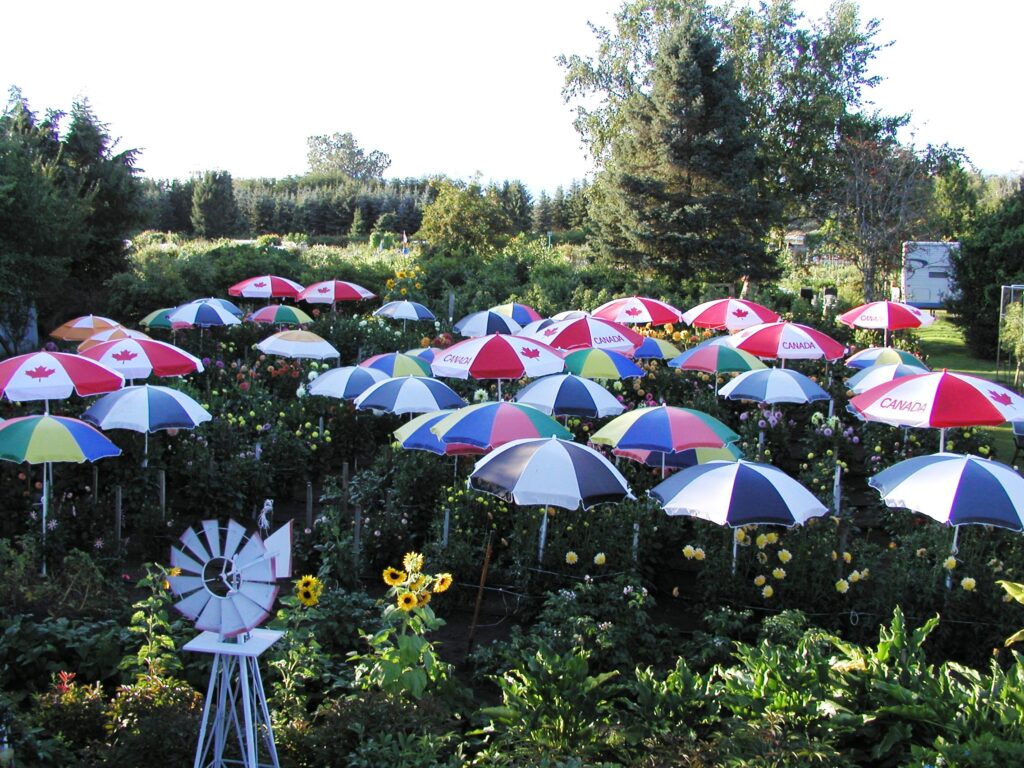
“We use umbrellas,” said Paul as 50-60 bright blue and yellow umbrellas canopy the show-bound blooms and stay up until the last show. He also ensures that the support for the umbrellas and metal stakes are not going to rub or knock the bloom.
The beds are watered on a slow drip system that comes on between midnight and five in the morning. The slow drip system ensures that the water penetrates deeply into the soil and moisture is not lost from evaporation.
Those blooms that are show-bound are cut the night before (Friday) and put into the greenhouse which is air conditioned. It’s usually the singles that go first and they are staged into pots ready for the show. The others are held in buckets of water and the triples are staged later. “When we bring them to the show they are ready to go on the table,” said Paul. The staged stems are staked “on either side” with pipe cleaner bridging from the stakes for stability. He uses Coca-Cola trays to seat the pots in and prevent them from falling over. “We don’t put on the tags until we get to the show,” he said, “because the pots have water that can splash and ruin them.” The 25-30 entries or more are transported in a pick-up truck that as a long box and canopy.
Head table words of wisdom
The Howards like many growers and showers belong to dahlia societies. They have learned from others and mentored new members. The couple holds memberships in the Snohomish County, Puget Sound, and Vancouver dahlia associations. They also belonged to the Fraser Valley Dahlia Society prior to it folding in 2024, with Paul acting as the Federation’s representative. Paul also holds senior judging credential and serves as a judge at major shows while Cheryl does clerking at shows. Becoming involved in societies has help broaden their knowledge and meet new growers who are also coping with many of the challenges of growing dahlias.
Today climate change is in itself a growing issue with raising up prize-worthy dahlias. For the past six years, the Howards have battled the rising temperatures. Dahlias prefer a temperature around 68°-72°F or 20°-22°C and slightly cooler nights 60°-64°F or 15°-17°C. But, B.C. has experienced temperatures rising well beyond those figures and the heat will cause plant stress as it climbs into 85°F (29°C) affecting growth and flowering. “They will wilt before they are open,” he said.
The hot weather has also brought more pests – a double threat to dedicated growers that take their plants across the border. Spider mites and thrips thrive in the warmer temperatures and can take their toll on emerging new growth and those sought-after show blooms. “I use a three-in-one rose spray,” said Paul, but thrips is tough to control as dry, hot weather sets up the conditions the insect thrives on.
But getting a bloom to unfurl unscathed is only part of the challenge. Paul tells of how Cheryl and he had prepared 24 entries for a U.S. show and when they got to the border, they were subjected to a plant inspection. Plant inspections don’t always occur, he said, but in this case the inspection found nine of the show blooms had some kind of infestation and were refused entry. “That’s a lot to lose,” he said as it left the couple with only 15 entries. But, Paul is philosophic. “We certainly don’t want to bring infected blooms to a show,” he said.
Unruly and rising temperatures, pests and the high-degree of care needed to produce a prize-winning bloom are all reasons a grower wanting to compete on a national level has to be in the garden monitoring what is happening. There is also the constant work of de-budding and deadheading to promote the plant’s energy into that perfect bloom.
“If you are going to show, you have to de-bud to get a beautiful flower,” he said, as his own trials have shown de-budding under ideal growing conditions is the path leading to that one big prize-winning bloom.
If the couple has any words of wisdom for those who want to beat a path to the head table in national shows, it is the simple message of monitoring the growth process in the garden. “You really have to be out there every day,” said Paul.
Some of the Howards’ wins include:
2024 – Vancouver Dahlia Society One-Day Late Show – Paul and Cheryl Howard winning both Best in Show (Aitara Rufus) and Best Triple in Show (Pam Howden).
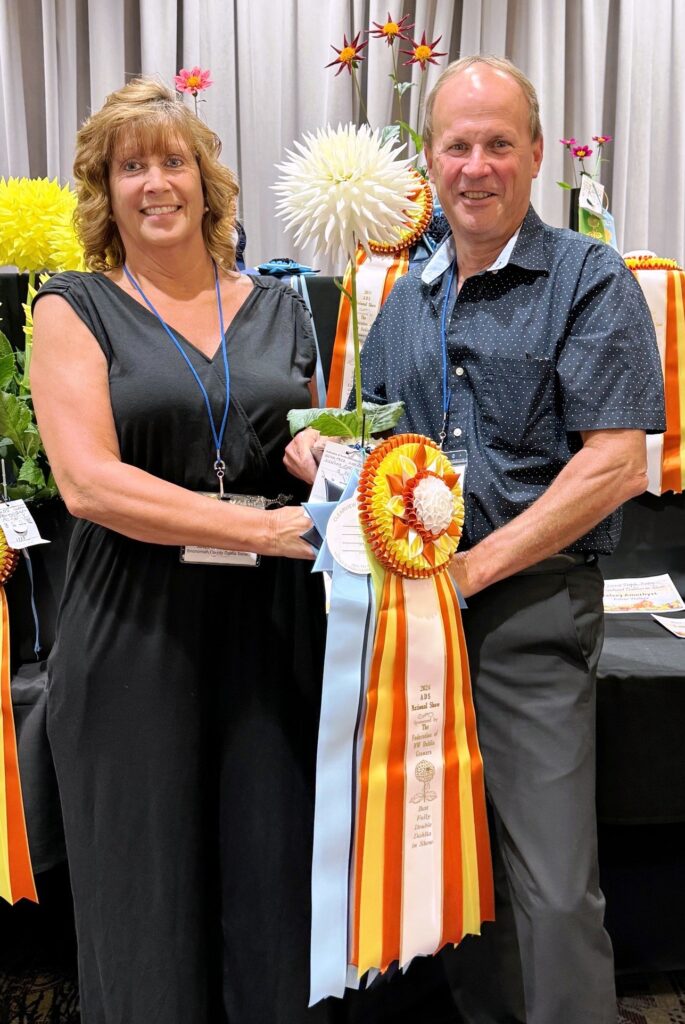
2024 – Paul and Cheryl Howard winning Best Fully Double dahlia at the 2024 American Dahlia Society National Show in Wenatchee, WA. The winning bloom is Kenora Challenger B SC W 2023 – American Dahlia Society national show. Paul and Cheryl Howard winning Best A Large (Clearview Edie), Best Triple BB small (Ruskin Andrea), Best A Large Open (Clearview Edie), Best Triple BB small open (Ruskin Andrea), Australia or New Zealand origination bloom (Pam Howden), and Canadian Origination Bloom (Lulu Island Mom).
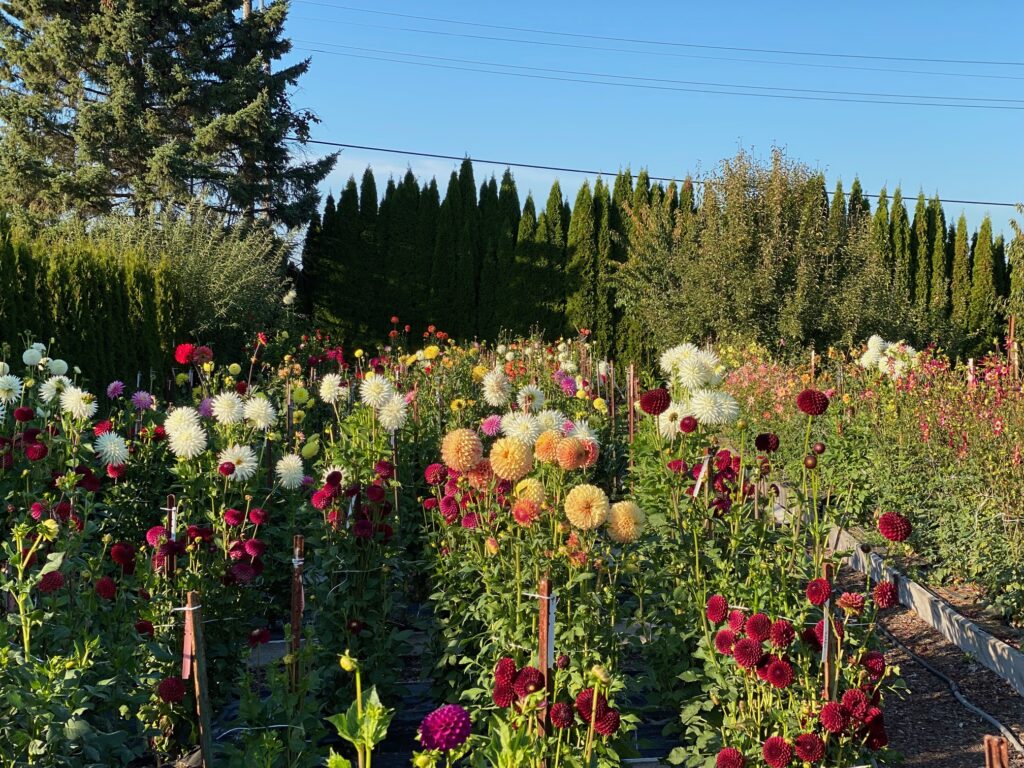
Cheryl and Paul’s Howard’s Surrey garden now provides the prize-winning dahlias that are taken to B.C. and U.S. shows with 280 dahlias planted each year.
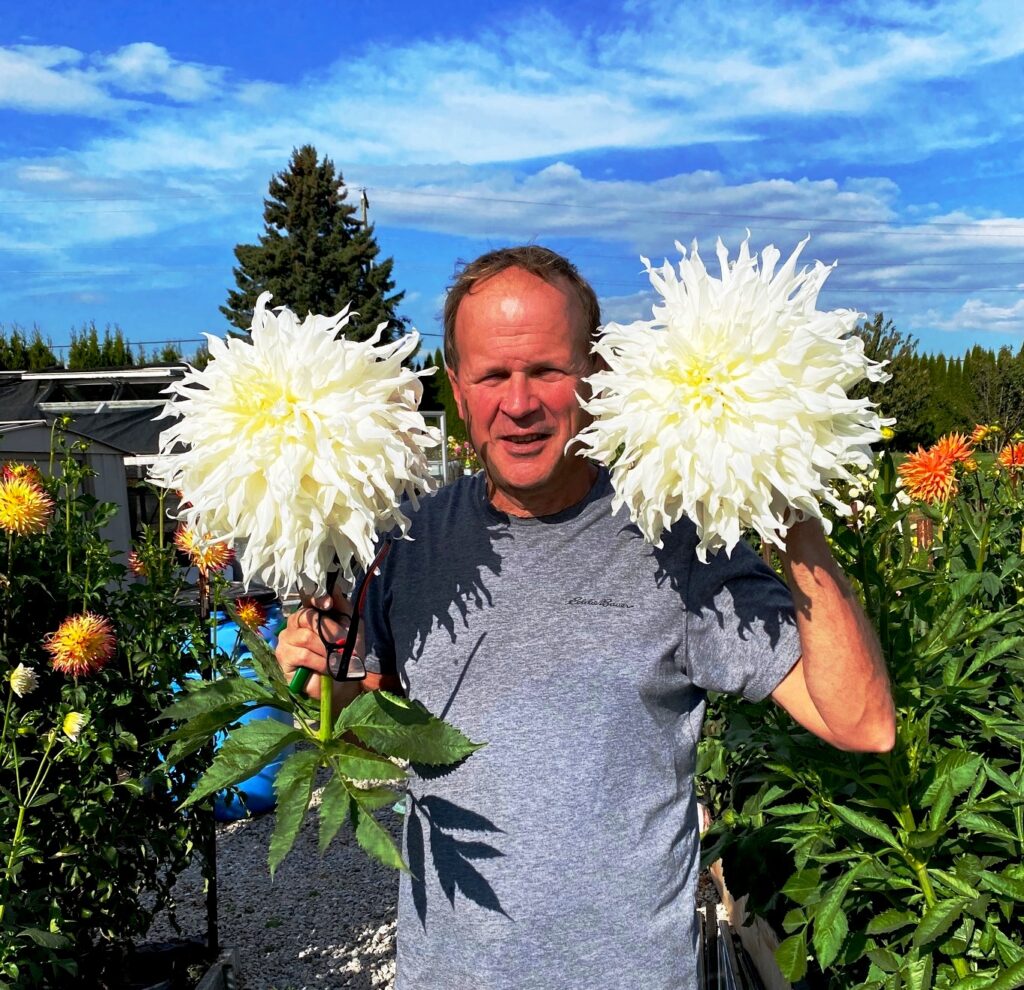
Paul up to his ears in huge dahlias